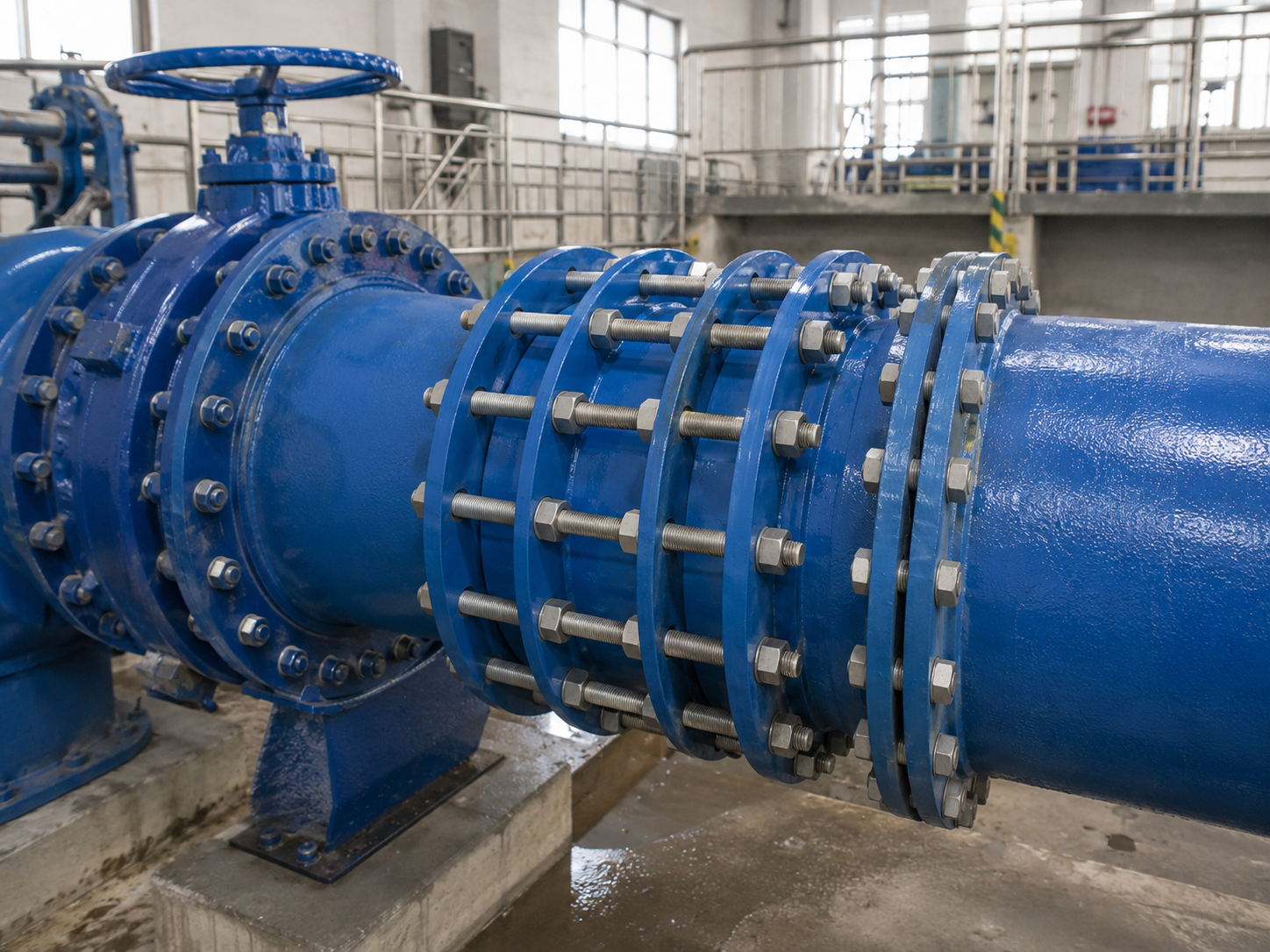
Water treatment plants, municipal pumping stations, desalination facilities, and wastewater systems often contain large, heavy flanged valves installed between fixed sections of steel pipeline.
In a perfectly aligned pipeline, installation may appear straightforward.
In real projects, however, civil structure settlement, fabrication tolerances, thermal movement, and accumulated dimensional deviations can create significant installation challenges.
When there is not enough axial clearance between two fixed flanges, engineers may be forced to adjust the pipeline, move connected equipment, or apply excessive bolt force to close the gap.
A properly engineered dismantling joint provides a much more controlled solution.
During pipeline construction, the actual distance between two flanged connections may differ slightly from the original design dimension.
Possible causes include:
Civil structure settlement
Pipeline fabrication tolerances
Installation deviations
Flange alignment errors
Equipment dimensional tolerances
Changes during site construction
When a heavy valve is installed between rigid pipe spools, even a relatively small gap difference can make alignment difficult.
Attempting to compensate for an excessive gap by forcing the flanges together with bolts can introduce unwanted mechanical loads into the valve and pipeline.
Excessive bolt stress
Flange distortion
Uneven gasket compression
Valve body loading
Difficulty achieving proper alignment
Increased installation time
Flange bolts are designed to secure a connection — not to compensate for major pipeline dimensional errors.
Large valves can be extremely heavy and difficult to remove from confined valve chambers or pumping stations.
Without an axially adjustable connection, maintenance teams may need to:
Disconnect multiple flanged connections
Remove or reposition sections of rigid piping
Move heavy valves through limited access areas
Re-align the pipeline during reinstallation
Replace or re-compress gaskets
Restore the pipeline after maintenance
This can increase labor requirements and extend planned shutdown periods.
For municipal water systems and critical infrastructure, every additional hour of maintenance can have an operational impact.
B-NAI double-flanged dismantling joints are engineered to provide controlled axial adjustment between flanged pipeline components.
The assembly typically consists of a central spigot and socket arrangement secured by high-strength tie rods, allowing the pipeline connection to be adjusted during installation and maintenance.
Installation Adjustment
Provides controlled axial movement to compensate for installation tolerances.
Valve Removal
Creates additional clearance for removing heavy flanged valves and equipment.
Pipeline Restraint
Tie rods help control longitudinal movement and transfer pressure thrust according to the joint design.
One of the primary advantages of a dismantling joint is its ability to provide controlled axial adjustment.
B-NAI dismantling joints can be engineered with an axial adjustment range such as ±50 mm, depending on the specific model and configuration.
This additional clearance can make it easier to:
Position large valves
Align flanges
Install gaskets
Connect bolts
Remove valves
Replace equipment
Compensate for installation tolerances
Fixed Pipe → Dismantling Joint → Valve → Dismantling Joint → Fixed Pipe
Instead of moving large sections of rigid pipeline, maintenance teams can use the controlled axial movement of the dismantling joint to create the required installation clearance.
More adjustment. Less pipeline disruption. Faster equipment maintenance.
B-NAI dismantling joints are manufactured from carbon steel materials such as Q235B or Q355B, depending on the required design and application.
The complete assembly can include:
Carbon steel body
Spigot
Socket sleeve
Flanges
High-strength tie rods
Nuts and washers
Elastomeric sealing components
The tie-rod system is designed to provide controlled longitudinal restraint and help manage end loads generated by internal pressure.
Heavy-duty carbon steel construction
High-strength restraint system
Robust flanged connections
Controlled axial adjustment
Suitable for large-diameter pipelines
Application-specific configuration
The sealing system is a critical part of any dismantling joint.
Depending on the service medium and operating conditions, elastomers such as EPDM or NBR can be selected.
Commonly selected for:
Raw water
Potable water applications
Wastewater
General water service
Outdoor water infrastructure
Often selected for applications requiring enhanced resistance to oils and certain hydrocarbon-containing fluids.
Material selection should always be based on the actual medium, temperature, pressure, applicable standards, and project requirements.
Reliable flange sealing
Flexible elastomeric sealing
Suitable for water applications
Application-specific material selection
Reduced risk of leakage when properly installed
The right gasket material is determined by the actual operating medium — not simply by pipe size.
Water infrastructure frequently operates in environments where steel components are exposed to:
High humidity
Groundwater
Condensation
Soil moisture
Chemical exposure
Long-term underground service
To improve corrosion protection, B-NAI dismantling joints can be supplied with Fusion Bonded Epoxy (FBE) or other specified coating systems according to project requirements.
The coating forms a protective barrier over the carbon steel surface and helps extend service life in demanding environments.
Valve pits
Underground vaults
Pump stations
Water treatment plants
Sewage treatment facilities
Desalination facilities
Municipal water pipelines
Fixed Pipe
↓
Flange
↓
Valve
↓
Flange
↓
Fixed Pipe
If the valve needs to be removed, the rigid pipeline may provide insufficient clearance.
This can require pipe modification, equipment repositioning, or additional dismantling work.
Fixed Pipe
↓
Dismantling Joint
↓
Valve
↓
Dismantling Joint
↓
Fixed Pipe
The dismantling joints can be adjusted to create installation and removal clearance while maintaining the flanged pipeline configuration.
Easier Installation → Faster Valve Removal → Reduced Pipeline Disruption
| Engineering Requirement | Dismantling Joint Advantage |
|---|---|
| Flange dimensional tolerance | Controlled axial adjustment |
| Heavy valve installation | Additional installation clearance |
| Valve removal | Easier axial disassembly |
| Pipeline maintenance | Reduced need to move rigid pipe sections |
| Internal pressure thrust | Controlled by tie-rod restraint |
| Underground installation | Protective coating options |
| Water service | EPDM / NBR sealing options |
| Large-diameter pipelines | Heavy-duty carbon steel construction |
The purpose of a dismantling joint is simple: make rigid pipeline systems easier to install, maintain, and service.
A dismantling joint should be selected according to the complete pipeline system rather than pipe diameter alone.
Key engineering parameters include:
DN, outside diameter, flange dimensions, and connection configuration.
The joint and restraint system must be suitable for the pipeline’s operating and design pressure.
Required installation and maintenance clearance should be determined before selecting the appropriate model.
Flange dimensions and drilling patterns must match the connected equipment and pipeline.
EPDM, NBR, or other elastomers should be selected according to the operating medium and conditions.
The coating should be selected according to installation environment and project specifications.
Large pumps and valves require reliable flanged connections and sufficient clearance for future maintenance.
Dismantling joints can simplify equipment installation and replacement while reducing the need to modify rigid pipeline sections.
Water treatment facilities contain numerous valves, pumps, flow meters, and other flanged components.
Controlled axial adjustment makes installation and maintenance more manageable.
Desalination facilities operate with large-diameter water pipelines and demanding environmental conditions.
Dismantling joints can provide installation flexibility while supporting reliable pipeline connections.
Wastewater systems require robust piping components capable of handling demanding operating environments.
Application-specific elastomers and protective coatings can be selected according to the service conditions.
For large buried or above-ground water pipelines, future valve replacement should be considered during the original pipeline design.
Installing dismantling joints at strategic equipment connections can make future maintenance significantly easier.
Q235B, Q355B, and other specified materials can be selected according to project requirements.
Tie-rod assemblies provide controlled longitudinal restraint and help manage pressure-induced end loads.
Controlled telescopic movement provides installation and maintenance clearance.
EPDM, NBR, and other sealing materials can be selected according to the operating medium.
FBE and other coating systems can be specified for demanding water and underground environments.
Dimensions, flange configurations, materials, coatings, and other parameters can be configured according to project requirements.
A dismantling joint may appear to be a relatively simple pipeline component.
Its real value, however, appears during installation and maintenance.
When a heavy valve needs to be installed or removed, controlled axial adjustment can eliminate unnecessary pipeline modification and reduce the amount of rigid pipe that must be disturbed.
For water infrastructure with large valves, pumps, and flanged equipment, planning for future maintenance is just as important as completing the initial installation.
Design for installation. Design for maintenance. Design for the life of the pipeline.
From municipal pumping stations and water treatment plants to desalination facilities and wastewater infrastructure, B-NAI dismantling joints provide a practical solution for managing installation tolerances and future equipment maintenance.
With heavy-duty carbon steel construction, high-strength restraint systems, application-specific sealing materials, and controlled axial adjustment, our dismantling joints are engineered for demanding water infrastructure applications.
Send us your pipeline and valve specifications, and our engineering team can help identify the appropriate configuration.
Pipe Size / DN
Valve Size
Working Pressure
Flange Dimensions
Flange Drilling Standard
Required Axial Adjustment
Pipeline Medium
Sealing Material
Coating Requirement
Installation Environment
Quantity
Project Application
Built for Pressure. Designed for Maintenance. Engineered for Infrastructure.