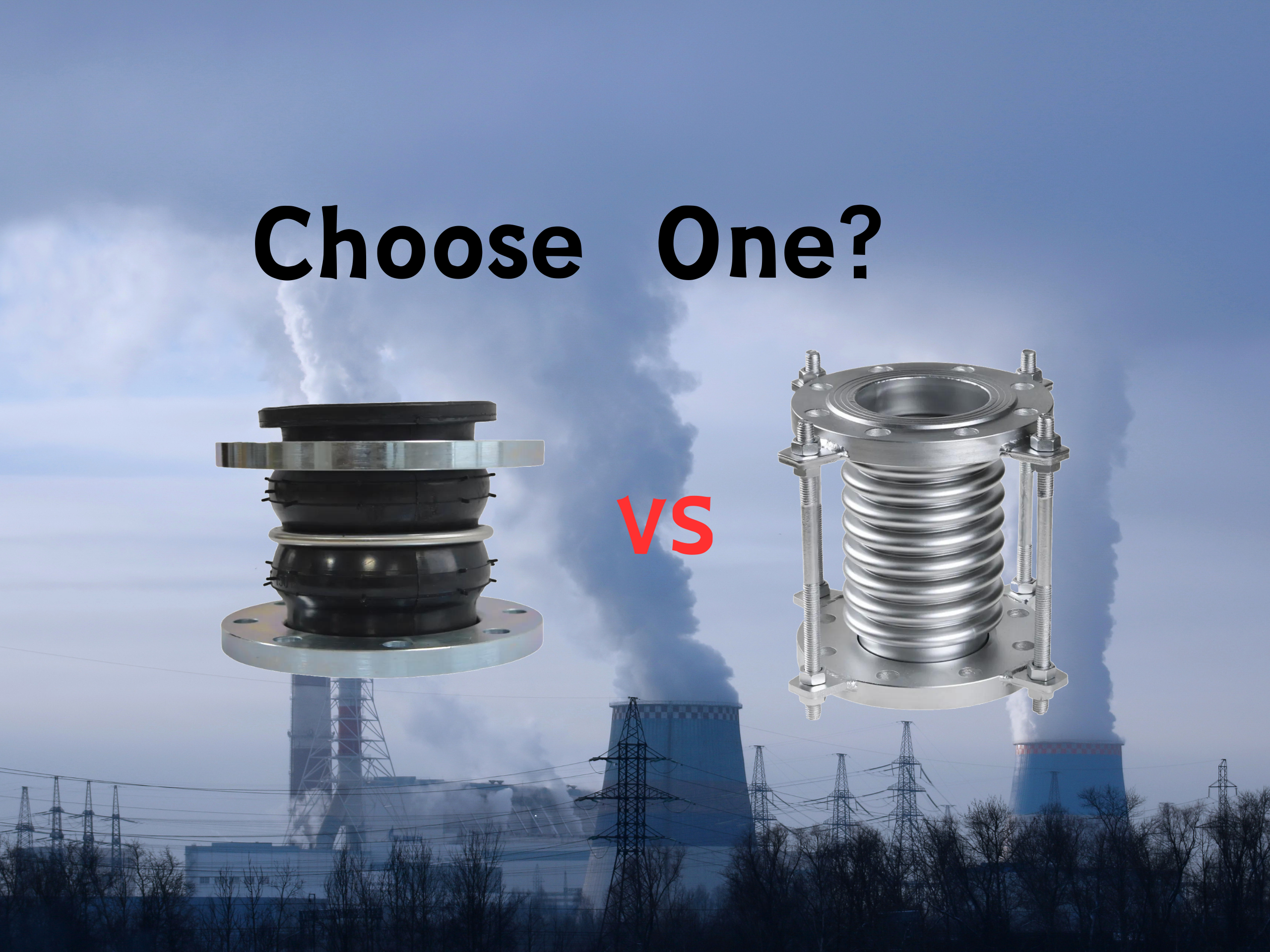
Expansion joints play an important role in industrial piping systems by accommodating movement, reducing the transmission of vibration, and helping protect connected equipment. However, rubber expansion joints and metal bellows expansion joints work differently and are designed for different operating conditions.
Choosing the wrong type may lead to premature wear, leakage, excessive loads on connected equipment, or unexpected maintenance costs. For engineers, contractors, and industrial buyers, the key is to understand the operating environment before selecting a product.
In this guide, we compare rubber and metal expansion joints, explain their main advantages and limitations, and outline the factors to consider when specifying an expansion joint for a water treatment plant, pumping station, power plant, HVAC system, or other industrial application.
A rubber expansion joint is a flexible pipe connector manufactured from elastomeric materials, often with reinforcing fabric and metal reinforcement. Depending on its design, it may feature a single sphere, double sphere, or another molded or fabricated body configuration.
Rubber expansion joints are commonly used in water supply systems, wastewater treatment plants, HVAC installations, industrial process piping, and pump connections.
Their flexibility allows them to accommodate specified amounts of axial, lateral, and angular movement. They can also help reduce vibration and noise transmitted through piping systems, especially when installed near pumps and other vibrating equipment.
Vibration and noise reduction: The elastomeric body can help isolate mechanical vibration and reduce structure-borne noise transmitted through connected piping.
Flexible movement capability: Depending on the design, size, pressure rating, and installation conditions, rubber joints can accommodate several types of movement.
Material options: Different elastomers can be selected according to the conveyed medium and operating environment. EPDM is commonly considered for many water-related applications, while NBR may be appropriate for certain oil-containing media. Actual compatibility must be confirmed for the specific fluid, temperature, concentration, and operating conditions.
Versatile connections: Rubber expansion joints are available with different flange arrangements, sizes, and body configurations to suit various piping layouts.
Rubber expansion joints have material-specific limits for temperature, pressure, chemical exposure, vacuum, and movement. They are not automatically suitable for every industrial service.
The rubber body can deteriorate when exposed to incompatible chemicals, excessive heat, ozone, abrasion, or operating conditions beyond its design limits. Some installations also require control rods, limit devices, or other restraint measures to manage pressure-induced forces and movement.
For this reason, engineers should evaluate the complete assembly rather than selecting a joint based on nominal pipe diameter alone.
A metal bellows expansion joint typically consists of a thin-walled corrugated metal bellows, end connections such as flanges or weld ends, and additional components when required by the design.
The corrugated bellows provides flexibility while maintaining a metallic pressure boundary. Stainless steel is commonly used for bellows construction, although the appropriate alloy depends on temperature, corrosion resistance, and the conveyed medium.
Metal bellows expansion joints are widely used in industrial process piping, steam systems, power generation, chemical processing, and other services where thermal movement or demanding operating conditions must be addressed.
Thermal movement accommodation: Metal bellows can be engineered to absorb pipe movement caused by temperature changes, including axial compression or extension and, in suitable designs, lateral or angular movement.
High-temperature applications: Metal construction can make these joints suitable for services beyond the operating range of many conventional rubber compounds. However, the allowable temperature depends on the alloy, pressure, cycle life, bellows geometry, and overall assembly.
Compact installation: Metal bellows expansion joints can provide a compact solution for specific movement requirements when the piping layout and design conditions are properly evaluated.
Design flexibility: Options may include single or multiple bellows, tie rods, hinges, gimbals, internal liners, and external covers. These components serve different purposes and must be selected for the actual application.
Metal bellows are sensitive to design and installation conditions. Excessive movement, pressure instability, improper alignment, torsion, or inadequate piping support may contribute to premature fatigue or failure.
The bellows can also be vulnerable to corrosion, erosion, mechanical damage, and flow-induced vibration. Internal liners or other protective measures may be required in certain applications.
Metal bellows expansion joints should therefore be selected and installed according to the manufacturer’s technical documentation and the piping system’s engineering requirements.
Although both products accommodate piping movement, their material properties and typical applications differ.
| Comparison factor | Rubber expansion joints | Metal bellows expansion joints |
|---|---|---|
| Main construction | Elastomeric body, often fabric-reinforced | Corrugated metallic bellows |
| Vibration isolation | Often a strong choice for pump and equipment vibration | Can accommodate movement, but is not automatically an equivalent vibration isolator |
| Thermal movement | Suitable within the specified rubber compound and assembly limits | Suitable when bellows geometry and material are engineered for the required movement |
| Temperature resistance | Depends strongly on the rubber compound | Depends on alloy, pressure, movement, and cycle requirements |
| Chemical compatibility | Depends on elastomer, reinforcement, and exposure | Depends on metal alloy, corrosion conditions, and any liner |
| Typical applications | Water, wastewater, HVAC, and many pump connections | Steam, industrial process lines, power generation, and demanding thermal services |
| Main design concerns | Elastomer compatibility, aging, pressure thrust, and movement limits | Fatigue life, corrosion, pressure stability, alignment, and piping restraints |
This comparison is a general selection guide, not a substitute for engineering verification. Neither product type is universally superior. A correctly specified rubber expansion joint may be more appropriate for a pump connection, while an engineered metal bellows joint may be more suitable for a high-temperature process line.
Rubber expansion joints are worth considering when vibration isolation, flexible connections, and compatibility with the conveyed medium are key priorities.
Pumps, blowers, and other rotating equipment can transmit vibration into connected pipelines. A properly selected rubber expansion joint can help reduce vibration transmission while accommodating the movement permitted by its design.
The rubber compound must be compatible with the water or wastewater chemistry, treatment chemicals, and operating temperature. Pressure surges and any vacuum conditions should also be evaluated.
Rubber expansion joints are frequently considered for pump connections because they can provide flexibility and help reduce vibration transmission.
However, they should not be used to compensate for poor pipe alignment or inadequate support. Pressure thrust and the manufacturer’s installation requirements must be considered, and the joint must not be subjected to movement beyond its rated capability.
In suitable heating, cooling, and water circulation systems, rubber expansion joints can help accommodate small movements and isolate equipment vibration. The selected elastomer must be compatible with the actual fluid and operating temperature.
For projects involving water, wastewater, or HVAC piping, review our rubber expansion joints to explore available product configurations.
Metal bellows expansion joints are worth considering when thermal expansion, temperature requirements, or specific process conditions call for a metallic flexible element.
Temperature changes can cause long pipe runs to expand and contract. A properly engineered metal bellows expansion joint can accommodate the specified movement and help manage thermal loads on the piping system.
Selection must account for design pressure, operating temperature, temperature cycles, material properties, and the required fatigue life. The allowable operating conditions should be confirmed for the complete assembly.
Power plants and industrial facilities often contain piping systems subject to repeated thermal cycles and complex movement patterns.
Depending on the application, engineers may specify axial, lateral, hinged, or gimbal-type expansion joints. The choice depends on the movement direction, pressure thrust management, piping layout, and restraint arrangement.
Stainless steel is not universally resistant to all chemicals. Engineers should assess the exact medium, concentration, temperature, impurities, and potential corrosion mechanisms before selecting a bellows alloy.
Where necessary, a suitable liner or alternative alloy may be considered, provided it meets the design requirements.
Explore our metal bellows expansion joints for product options and configuration details.
Before requesting a quotation, prepare the following information. It will help the supplier evaluate whether a rubber or metal expansion joint is appropriate for the application.
Provide normal and maximum operating temperatures, design pressure, pressure fluctuations, and any vacuum conditions.
Do not select a product using temperature or pressure in isolation. The permitted combination of these conditions depends on the specific product design and materials.
Identify the fluid or gas, including relevant chemical concentrations and any suspended solids or abrasive particles.
For rubber joints, confirm elastomer compatibility. For metal bellows, confirm the suitability of the bellows alloy and any protective components.
Determine the expected axial, lateral, and angular movements. If the system experiences several types of movement simultaneously, provide the combined movement requirements rather than evaluating each direction separately.
Movement capacity must be checked against the manufacturer’s rated values and fatigue requirements.
Specify nominal pipe diameter, actual mating dimensions where necessary, flange standard, pressure class, facing, drilling, and connection type.
These details help ensure that the selected joint fits the piping system and can be installed correctly.
Provide a simple piping drawing or installation photograph when possible. Include the locations of anchors, guides, supports, pumps, valves, and other equipment.
Also indicate the expected number of thermal or pressure cycles, available installation space, and any special maintenance requirements.
These details are particularly important for metal bellows design and for evaluating pressure thrust and movement control in either type of joint.
Choosing by diameter alone. Two joints with the same nominal diameter may have very different pressure ratings, movement capacities, and material suitability.
Ignoring pressure thrust. Internal pressure can generate significant forces that must be managed by the piping system, anchors, restraints, or the expansion joint’s engineered design.
Assuming every stainless steel alloy is suitable for every chemical. Corrosion resistance depends on the alloy and actual service conditions.
Using a flexible joint to correct major misalignment. Expansion joints have defined movement limits. They should not be forced into position or used to compensate for an incorrectly installed pipeline.
Overlooking installation instructions. Incorrect bolt tightening, flange alignment, handling, or support arrangements can shorten service life.
Avoiding these mistakes starts with accurate operating data and a clear understanding of the piping system.
Neither is universally better. Rubber expansion joints are often considered for vibration isolation and many water-related services, while metal bellows are frequently used for engineered thermal movement and demanding temperature conditions. The correct choice depends on the complete operating envelope.
Only if the selected compound and complete assembly are rated for the actual temperature, pressure, medium, and movement. Do not assume that every rubber joint is suitable for high-temperature service.
Piping restraints and anchors must be designed to manage pressure thrust and movement forces. The requirements depend on the expansion joint configuration and the piping system design. Follow the manufacturer’s design documentation and applicable engineering standards.
Select the correct materials, stay within the rated operating conditions, install the joint without introducing unwanted loads or torsion, maintain appropriate supports and restraints, and inspect the assembly according to the operating environment and manufacturer’s recommendations.
Provide the nominal diameter, quantity, medium, operating and design pressure, temperature range, required movement, connection standard, installation conditions, and destination market. Drawings, photographs, and project specifications can help clarify requirements.
Rubber and metal bellows expansion joints solve related but different piping challenges. Rubber joints are often attractive for vibration isolation and flexible connections, while metal bellows can provide an engineered solution for thermal movement and demanding industrial conditions.
The best choice is the one that meets the system’s pressure, temperature, chemical compatibility, movement, fatigue, and installation requirements.
If you are planning a new piping project or replacing an existing expansion joint, share your operating conditions and connection details with our team. We can review your requirements and help identify a suitable product configuration for further technical evaluation and quotation.
Contact B-Nai for Industrial Piping Solutions
Website: https://www.b-nai.com/
Email: bainai@b-nai.com
WhatsApp/WeChat: +86 132 7159 1237